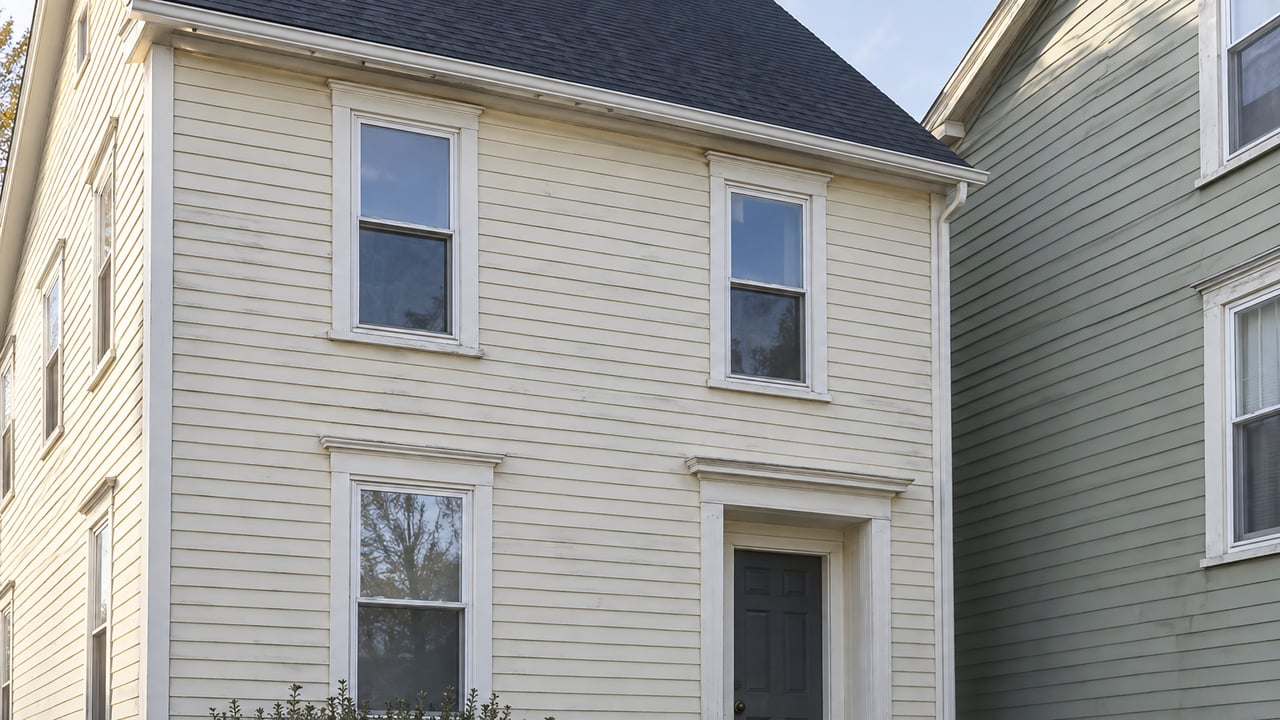
A buyer touring Bayonne this fall could spend a Saturday morning walking through a hundred-year-old two-family in the city's interior, complete with original moldings and a driveway shared with the house next door, then drive across town to a brand-new one-bedroom unit inside a tower rising on the old Military Ocean Terminal, with a clear line of sight to the Statue of Liberty. Both listings say Bayonne. Both sit inside the same municipal boundary and the same zip code. And the price-per-square-foot math behind them is currently moving in close to opposite directions.
That mismatch is not a fluke of two odd listings. It is what happens when one city's sales data gets used to describe two structurally different housing products: the pre-war duplexes and small multifamily buildings that still make up most of Bayonne's older neighborhoods, and the new mid- and high-rise construction going up on the reclaimed waterfront and along the Route 440 corridor. Bayonne is not getting uniformly more expensive. It is splitting into two markets that happen to share a boundary line.
What the Citywide Median Isn't Telling You
Over the three months ending May 2026, the median sold price for a Bayonne home was $663,000, up 6.1 percent from the same period a year earlier. In that same window, the average sale price was $580,000, down 3.3 percent year over year. A rising median alongside a falling average is not a contradiction. It is usually a sign that the mix of what's actually closing has shifted, not that any single type of home suddenly costs more or less.
Sales volume backs that up. Only 69 homes sold in May 2026, down from 88 the year before, a drop of roughly 22 percent. Fewer transactions, moving in different directions depending on which statistic you read, points to a market where composition is doing more work than price appreciation.
The gap widens further once you compare sold data to active listings. In August 2026, homes listed for sale in Bayonne carried a median asking price of $528,000 at $349 per square foot, a full $135,000 below that spring sold median. Two trackers, two windows, two very different numbers, both accurate for what they measure. A single "Bayonne price" pulled from any one source is compressing more variation than it appears to on the surface.
A City Built From Two Very Different Eras
This isn't a new phenomenon so much as a newly visible one. Roughly 46 percent of Bayonne's housing units are duplexes or small multifamily conversions, and about 36 percent of the city's housing stock predates 1939. Another third sits in larger apartment and high-rise buildings, with single-family detached homes and rowhouses making up the rest. Bayonne has always been dense and layered by era.
What's changed is where new supply is landing. Almost none of it is going into the older interior blocks. Nearly all of it is concentrated on the reclaimed waterfront, known as the Peninsula at Bayonne Harbor, and in scattered infill sites just across Route 440.
| Legacy interior neighborhoods | The Peninsula and Route 440 infill | |
|---|---|---|
| Typical build era | Pre-1939, dominated by duplexes and small multifamily conversions | New construction, largely 2020s and later |
| Common unit type | Two-family homes, small multifamily buildings | Condo and rental towers, smaller unit footprints |
| Recent pricing signal | Citywide figures run around $348 to $349 per square foot (three months ending May 2026 / August 2026 listings) | Condo list price per square foot climbed 9.38 percent week over week, versus 1.93 percent for single-family stock |
| What's changing the map | Little new supply; values track the broader city trend | Zoning already permits towers up to 50 stories on one parcel; an 8-story, 165-unit project cleared its first Planning Board hearing in July 2026 |
Single-family homes still carry roughly a $33 per square foot premium over condos on average across the city. But the short-term momentum sits almost entirely on the condo side, which is exactly where the Peninsula's new product lives.
The Regulatory Ceiling Already Moved Once
Two years ago, in 2024, Bayonne's City Council voted to raise the height limit on a 23-acre parcel called HS-1, spanning the block between Goldsborough Drive and East 40th Street within the Harbor Station South district. The change allows buildings as tall as 50 stories, nearly double the 26-story NY Vue tower that had been the Peninsula's tallest structure. No specific project of that scale had been proposed at the time, but the zoning ceiling now exists for a developer to use.
The pipeline isn't confined to the literal peninsula, either. In July 2026, the Alessi Organization, the firm behind Bayonne's South Cove Commons, filed plans for Peninsula View, an eight-story building with 165 residences on a roughly one-acre site at 75-87 East 31st Street. The land fronts Route 440 but is only reachable by East 31st Street, East 32nd Street, and Prospect Avenue. Bayonne's Planning Board heard the application on July 14, 2026, its first meeting under Mayor Sharon Ashe-Nadrowski and a new City Council that had taken office on July 1.
Not every acre on the Peninsula is heading toward denser building, though. In August 2026, the City Council amended the redevelopment plan for a 10-acre, city-owned parcel at Harbor Station North, pulling it out of industrial use and shifting it toward commercial-recreational use rather than more residential towers. Residents pressed the council on drainage, flooding, and whether the site would include guaranteed public park space. One resident urged the city to preserve the land instead as parkland connected to the South Waterfront Walkway, describing the site's current use by wildlife:
"Bald eagles, osprey, great blue herons... numerous songbirds use it nesting area during the summer."
Bayonne sits on a peninsula bordered by water on three sides, and a meaningful share of its properties carry some degree of flood risk. That geography is part of why drainage came up repeatedly at the hearing, and why the outcome on this particular parcel leaned toward open space rather than another building footprint.
What This Means If You're Comparing Neighborhoods
If you're weighing Bayonne against another North Jersey town using a single median price pulled off a portal, it helps to know which submarket that number is actually describing. A two-family in the interior and a new one-bedroom near the Cape Liberty cruise terminal, served by the Hudson-Bergen Light Rail's 8th Street, 34th Street, and 45th Street stations, are different products with different ownership structures. The older multifamily stock can offer rental income from a second unit that offsets a mortgage payment. New construction on the Peninsula typically comes with condo association fees and rules that don't apply to a deed for a two-family house.
Timing matters too. Citywide, homes averaged 34 days on the market over the three months ending May 2026, up from 29 days the year before. Longer marketing time alongside a rising median isn't the profile of a single overheated segment. It looks more like a market absorbing a wider range of product than it was a year or two ago, with buyers taking a bit more time to figure out which side of the city, and which kind of building, actually fits what they're trying to do.
The Peninsula's build-out is still in motion, with a height allowance already on the books, a mid-rise infill project moving through approvals, and at least one parcel just redirected toward park use after residents pushed back. That combination means the map of what's available, and at what price per square foot, is likely to keep shifting for a while yet.
A Few Direct Questions
Is Bayonne's median home price rising or falling right now? It depends on the measure. The three-month sold median through May 2026 was up 6.1 percent year over year at $663,000, while the average sale price for that same window was down 3.3 percent at $580,000. August 2026 listing data put the asking median lower still, at $528,000. The direction changes based on whether you're looking at recent closings, current listings, or an average versus a median.
Where is most of the new construction happening? Almost entirely on the Peninsula at Bayonne Harbor redevelopment and in infill sites along Route 440, such as the proposed Peninsula View project. The older interior neighborhoods, still dominated by pre-1939 duplexes and small multifamily buildings, are seeing very little new supply.
Does more construction on the Peninsula mean the whole city's prices will follow? Not automatically. Even within the Peninsula district, the city recently redirected a 10-acre parcel away from denser development toward park and commercial-recreational use after residents raised drainage and flooding concerns, which shows the build-out isn't guaranteed to proceed the same way on every remaining site.
If you're trying to figure out which side of Bayonne's split market actually fits your timeline and your budget, whether that's a two-family with rental potential or a new build near the waterfront, Ask Agent Alexa can walk you through what's currently active on both sides of the city and what each one is likely to mean for your resale math down the road.