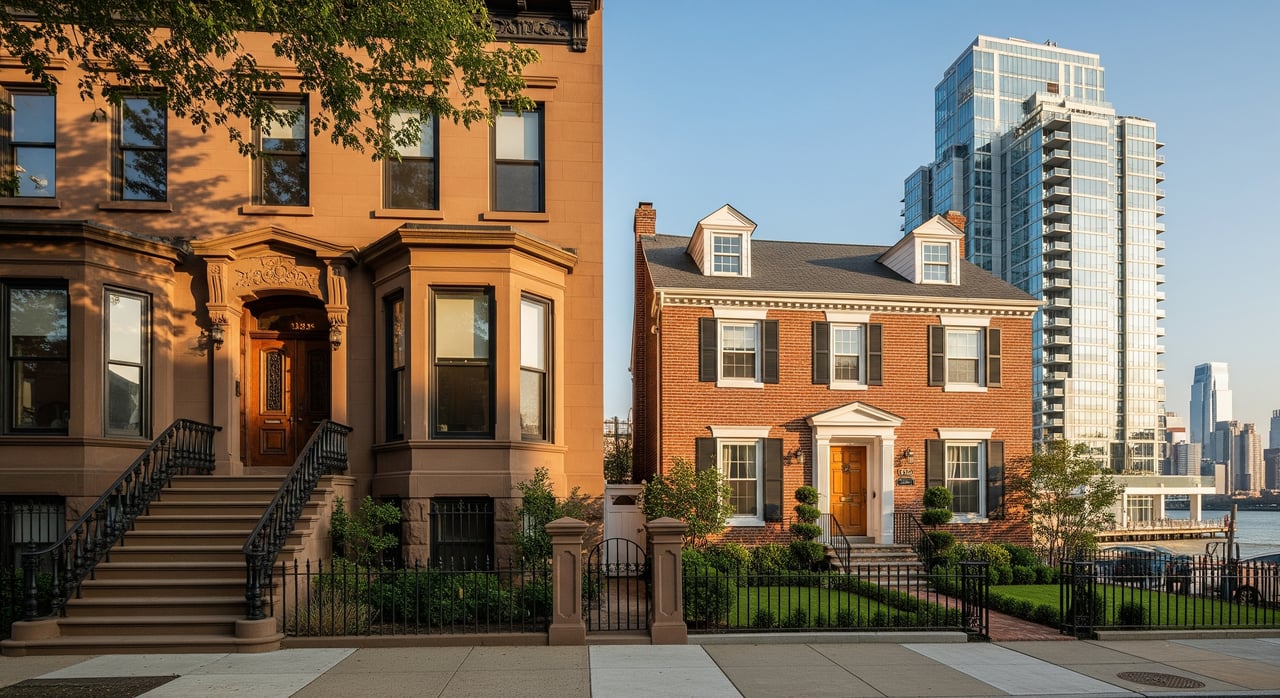
Debating between a condo, a brownstone, or a single-family house in Jersey City? You are not alone. The right choice depends on how you live, what you want to spend now and later, and how you feel about shared rules, maintenance, and renovations. In this guide, you will learn how each option works, what it really costs, where you will find them across the city, and how to avoid common surprises. Let’s dive in.
What each option means
Condos in Jersey City
Condos give you ownership of your unit plus shared ownership of common areas. You pay a monthly HOA fee that covers building operations, common-area insurance, reserves, and amenities. You will see the highest concentration downtown along the waterfront and around PATH stations, with more midrise buildings near Journal Square and Hamilton Park.
This setup often suits commuters, first-time buyers, and anyone who wants amenities and convenience with less day-to-day upkeep.
Brownstones and townhouses
Locally, “brownstone” usually refers to historic rowhouses and townhouses. Some are fee-simple homes where you own the whole building and lot. Others are subdivided into condo units with shared governance. Many sit within historic districts around Paulus Hook, Hamilton Park, and nearby blocks, which can affect what you may change on the exterior.
These homes appeal if you want architectural character, a stoop or yard, and a house-like feel in a walkable setting.
Single-family houses
A detached single-family house gives you full control of the property and all maintenance. You will find more of these in The Heights, Greenville, Bergen-Lafayette, and areas away from the waterfront. Expect more space and often a yard or parking, with responsibility for every system and surface.
This option fits buyers who want maximum privacy, outdoor space, and flexibility, and who are comfortable managing upkeep.
Monthly and yearly costs
Your real cost is not just the purchase price. It is the sum of mortgage, taxes, insurance, HOA fees if any, utilities, and ongoing maintenance. Here is a quick responsibility snapshot.
| Cost item | Condo | Brownstone/Townhouse | Single-family house |
|---|---|---|---|
| Mortgage | Owner | Owner | Owner |
| Property taxes | Owner | Owner | Owner |
| Home insurance | HO-6 for interior; building insures common areas | HO-3 or similar covers structure and liability | HO-3 or similar covers structure and liability |
| HOA/condo fees | Yes | Sometimes, if part of a condo association | No |
| Exterior maintenance | Association | Owner (unless part of condo) | Owner |
| Utilities | Often partially bundled | Separate | Separate |
| Reserves/capital projects | Association-managed | Owner-managed | Owner-managed |
HOA fees and what to review
HOA fees fund building staff, maintenance, common-area insurance, and reserves. Downtown high-rises with amenities usually cost more per month than small low-rise associations. Thin reserves can lead to special assessments. Before you offer, review:
- Reserve study and balance
- Special assessment history and any planned projects
- Insurance certificate and coverage levels
- Rental, pet, and short-term rental rules
- Owner-occupancy ratios and financial statements
Property taxes in New Jersey
New Jersey property taxes are among the highest in the country. The total bill depends on assessed value and local levies. Single-family houses often carry higher total bills than comparable condos because of assessed value, but there are exceptions. Ask for the current tax bill on any property you are considering and factor in how renovations may change assessment.
Insurance and flood risk
- Condos: Your HO-6 policy covers the interior and personal property, while the association insures common elements.
- Brownstones/houses: Policies like HO-3 cover the structure, liability, and personal property. Older structures or homes in mapped flood zones often see higher premiums.
Large parts of Jersey City, especially along the waterfront and low-lying areas, fall within FEMA flood zones. If a property is in a mapped floodplain, lenders will require flood insurance. Check your specific address on the FEMA Flood Map Service Center for an early read on risk. You can search official FEMA maps at the FEMA Flood Map Service Center.
- Tip: Get a flood insurance quote before you waive contingencies or finalize your budget.
Financing and inspections
Financing differences
- Condos: Lenders review the building’s insurance, reserves, owner-occupancy, and any commercial-space mix. Newly converted or very small associations can be tougher for financing, which may slow closings.
- Brownstones/townhouses: If fee simple, they are typically financed like houses. If you are buying a unit in a converted brownstone that is a condo, condo rules apply.
- Single-family houses: Conventional, FHA, and VA financing are common. Renovation loan options are more straightforward for houses than for condos.
Inspection focus by property type
- Condos: You will inspect the unit interior and rely on association disclosures for building systems, façade, roof, and elevators. Special assessments related to common elements can be a risk factor.
- Brownstones: Older homes can hide costly issues. Look closely at roof, foundation and structure, masonry and lintels, plumbing, electrical (including any knob-and-tube wiring), and pests. Budget time and cost for specialized trades.
- Single-family houses: Inspect drainage, yard conditions, and all systems. If any home uses private systems, add the appropriate specialty inspections.
Historic districts and permits
Parts of Hamilton Park, Van Vorst Park, Paulus Hook, and nearby blocks have historic protections. Exterior changes typically require review and approval, which can add time and cost. Most significant renovations also require building permits, and older properties may need upgrades to meet current code.
Short-term and rental rules
Jersey City regulates short-term rentals, and many associations restrict them. If you plan to rent, verify city rules and the building’s bylaws before you buy.
Neighborhood fit in Jersey City
Downtown, Exchange Place, Newport, Paulus Hook
- What you will find: Mostly condos in high-rises with amenities. Some converted brownstone options in Paulus Hook and near Hamilton Park.
- Why it works: High walkability, restaurants, waterfront parks, and PATH access to Manhattan.
- Tradeoffs: Higher prices per square foot, smaller private outdoor space, and often higher HOA fees.
Hamilton Park, Van Vorst Park, Journal Square
- What you will find: Historic brownstones, low-rise condos, and new midrise development, with larger redevelopment around the Journal Square transportation hub.
- Why it works: Historic character, park access, and evolving transit-oriented development.
- Tradeoffs: Brownstones may need more maintenance; quality and HOA structures vary across new buildings.
The Heights and nearby corridors
- What you will find: More single-family houses, duplexes, rowhouses, plus modest condos.
- Why it works: More interior space and yards, city and skyline views in some spots, and a quieter residential feel.
- Tradeoffs: Longer trips to PATH from some blocks, though bus and Light Rail options exist.
Bergen-Lafayette, McGinley Square, Greenville
- What you will find: A larger share of single-family homes and duplexes, with pockets of redevelopment.
- Why it works: More affordability and room to grow.
- Tradeoffs: Varying walkability and longer commutes depending on block.
West Side and the Journal Square corridor
- What you will find: Newer midrise condos and older multifamily buildings, generally at lower prices than the waterfront.
- Why it works: Transit-oriented projects and entry points for first-time buyers.
- Tradeoffs: Quality and HOA structuring can vary; change is ongoing.
Offer dynamics and timing
Condos
Desirable units near PATH, with views or strong amenities, can see multiple offers. Cash or well-prepared financing helps, since condo underwriting can add time. HOA financials and any pending capital projects often become negotiation points.
Brownstones and townhouses
Well-maintained historic brownstones are scarce and can draw heavy competition. Condition varies widely. Inspection contingencies and realistic repair scopes matter, since masonry, structural, and roofing fixes can be significant.
Single-family houses
Competition depends on location and price tier. Homes that offer parking or yards in in-demand blocks can get multiple offers. In other areas, buyers often have more room to negotiate.
Contingencies
Some buyers consider waiving appraisal or inspection in hot markets. That carries higher risk with older brownstones and houses. Balance speed with due diligence.
Renovation and resale
- Renovating brownstones: Expect specialized trades for masonry, lintels, foundation, and older electrical. Permits and historic review can extend timelines.
- Renovating condos: Interior updates are common. Associations control windows, façades, and other exterior components, so check rules early.
- Resale patterns: Scarce, well-located brownstones and downtown condos near PATH tend to hold strong demand. New condo supply can pressure older condo resale pricing, while single-family houses appeal to a different pool that values space and outdoor areas.
Decision checklist
Use this quick checklist to narrow your fit:
- Commute: Do you need to be near PATH or bus and Light Rail, or can you trade transit speed for more space?
- Outdoor space: Do you want a yard, deck, or just convenient park access?
- Maintenance tolerance: Are you comfortable managing roof, façade, and systems, or do you prefer association-managed upkeep?
- HOA rules: Are you okay with bylaws and shared governance, or do you want full autonomy?
- Renovation appetite: Are you open to historic approvals and contractor coordination, or do you prefer turnkey?
- Flood exposure: Will you accept a mapped flood zone if the building has mitigation, or do you want to avoid flood insurance?
- Investment plans: Do you need rental flexibility, and what do the HOA and city allow?
- Resale goals: Are you prioritizing scarcity and character, amenities and convenience, or maximum space for your budget?
Next steps
Before you submit an offer, protect your budget and timeline with targeted due diligence:
- Request HOA documents: bylaws, financials, reserve studies, meeting minutes, and insurance certificates.
- Order the right inspections: add structural, masonry, chimney, or pest specialists for older brownstones.
- Confirm flood status and premium: check FEMA maps and get a quote early.
- Verify taxes and utilities: ask for recent bills and assessment history.
- Check historic overlays and permits: understand what approvals your plans will require.
- Clarify parking and storage: confirm any deeded or assigned spaces and building policies.
- Align financing: confirm your lender’s condo approval process and timeline if you are buying a condo.
If you want help mapping these tradeoffs to your budget and lifestyle, connect with a local, concierge-level advisor. Reach out to Alexa Micciulli to compare options, pressure-test monthly costs, and craft a winning offer strategy.
FAQs
What is the main cost difference between a condo and a house in Jersey City?
- Condos add HOA fees that cover building operations and reserves, while houses avoid HOA fees but require you to fund all exterior and system maintenance yourself.
How do historic districts affect owning a brownstone in Jersey City?
- Exterior changes usually need review and approval, which can add time and cost to renovations; plan ahead for permits and preservation guidelines.
Are condos harder to finance than single-family homes?
- They can be, because lenders evaluate the association’s reserves, insurance, and owner-occupancy; small or newly converted buildings can take longer to clear underwriting.
Where are most single-family houses in Jersey City?
- You will find more detached homes in The Heights, Greenville, and Bergen-Lafayette, with fewer options near the waterfront.
Do I need flood insurance in Jersey City?
- If the property is in a mapped FEMA flood zone and you have a mortgage, lenders will require flood insurance; confirm the map and get a quote before you commit.
Can I use short-term rentals like Airbnb in a Jersey City condo?
- Many associations restrict short-term rentals and the city regulates them; verify both building bylaws and local ordinances before you buy.
What inspections are essential for an older brownstone?
- Beyond the general inspection, add specialists for roof, structure, masonry and lintels, electrical, plumbing, and pests to uncover costly hidden issues.